Abstract
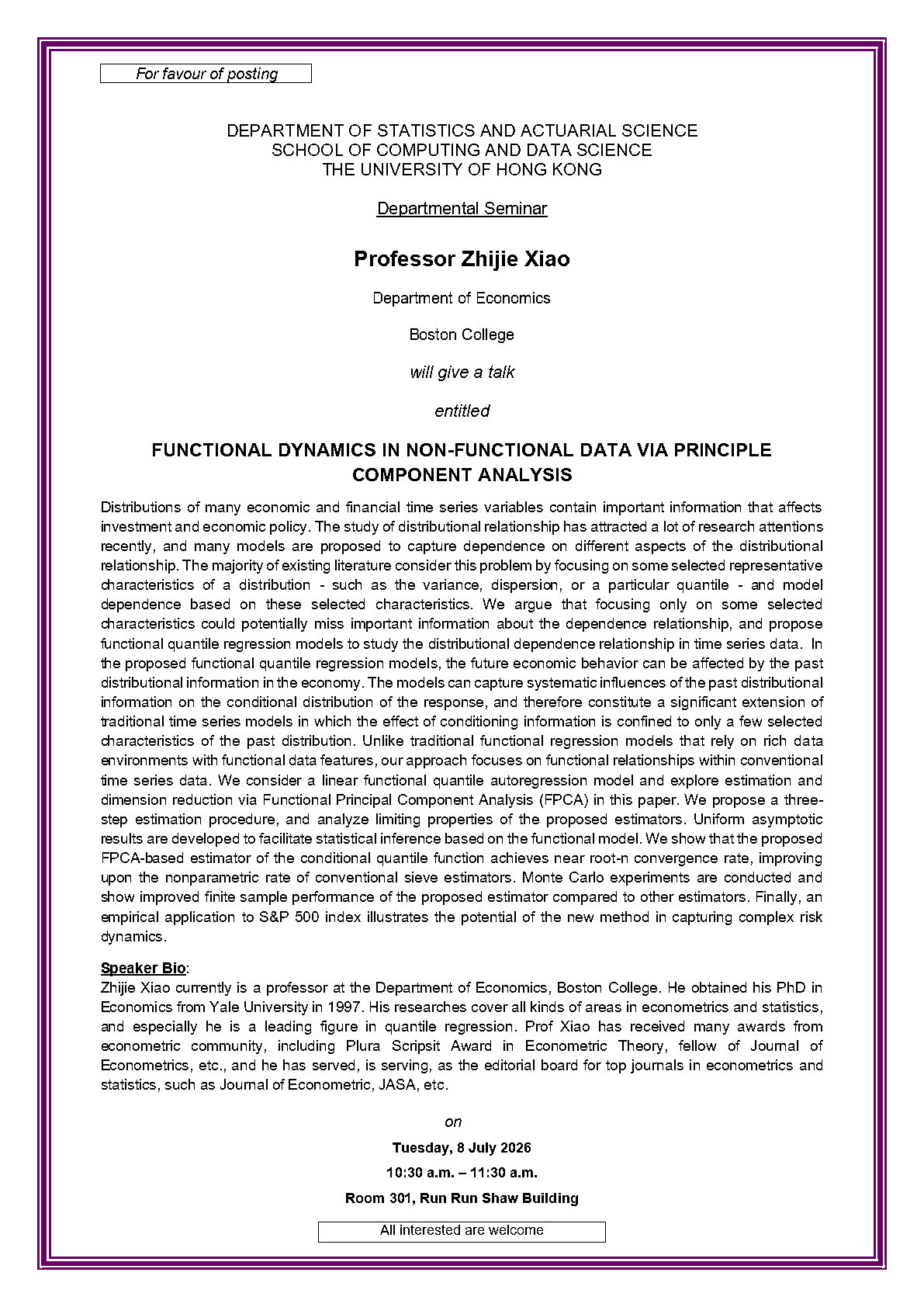
Distributions of many economic and financial time series variables contain important information that affects investment and economic policy. The study of distributional relationship has attracted a lot of research attentions recently, and many models are proposed to capture dependence on different aspects of the distributional relationship. The majority of existing literature consider this problem by focusing on some selected representative characteristics of a distribution - such as the variance, dispersion, or a particular quantile - and model dependence based on these selected characteristics. We argue that focusing only on some selected characteristics could potentially miss important information about the dependence relationship, and propose functional quantile regression models to study the distributional dependence relationship in time series data. In the proposed functional quantile regression models, the future economic behavior can be affected by the past distributional information in the economy. The models can capture systematic influences of the past distributional information on the conditional distribution of the response, and therefore constitute a significant extension of traditional time series models in which the effect of conditioning information is confined to only a few selected characteristics of the past distribution. Unlike traditional functional regression models that rely on rich data environments with functional data features, our approach focuses on functional relationships within conventional time series data. We consider a linear functional quantile autoregression model and explore estimation and dimension reduction via Functional Principal Component Analysis (FPCA) in this paper. We propose a threestep estimation procedure, and analyze limiting properties of the proposed estimators. Uniform asymptotic results are developed to facilitate statistical inference based on the functional model. We show that the proposed FPCA-based estimator of the conditional quantile function achieves near root-n convergence rate, improving upon the nonparametric rate of conventional sieve estimators. Monte Carlo experiments are conducted and show improved finite sample performance of the proposed estimator compared to other estimators. Finally, an empirical application to S&P 500 index illustrates the potential of the new method in capturing complex risk dynamics.
About the speaker
Zhijie Xiao currently is a professor at the Department of Economics, Boston College. He obtained his PhD in Economics from Yale University in 1997. His researches cover all kinds of areas in econometrics and statistics, and especially he is a leading figure in quantile regression. Prof Xiao has received many awards from econometric community, including Plura Scripsit Award in Econometric Theory, fellow of Journal of Econometrics, etc., and he has served, is serving, as the editorial board for top journals in econometrics and statistics, such as Journal of Econometric, JASA, etc.