|
Past Seminars and Events
|
| July 03, 2026 |
-
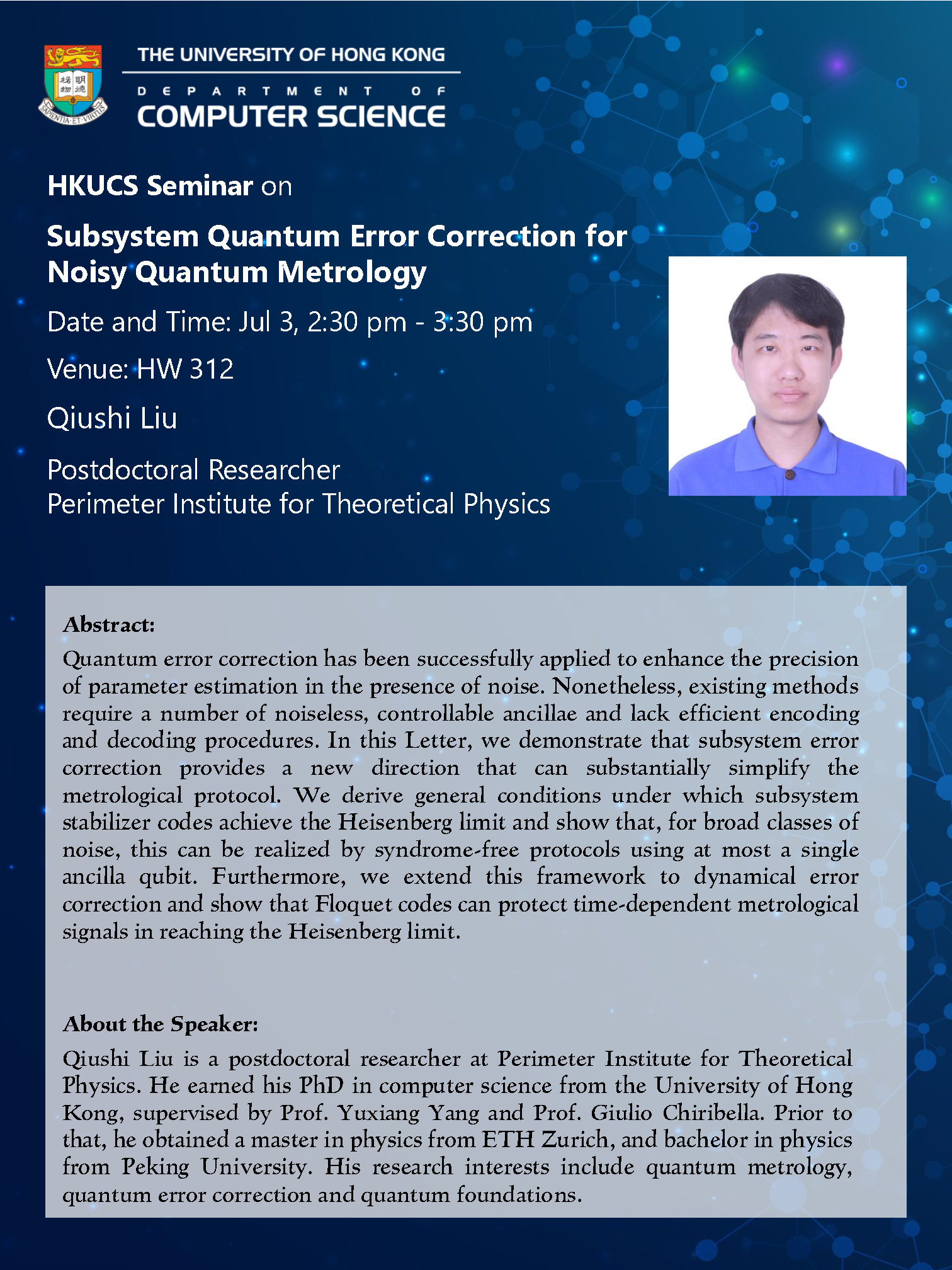
Title: Subsystem Quantum Error Correction for Noisy Quantum Metrology
Time: 02:30pm
Venue: HW312, Haking Wong Building, HKU
Speaker(s): Dr. Qiushi Liu
Remark(s): Abstract
Quantum error correction has been successfully applied to enhance the precision of parameter estimation in the presence of noise. Nonetheless, existing methods require a number of noiseless, controllable ancillae and lack efficient encoding and decoding procedures. In this Letter, we demonstrate that subsystem error correction provides a new direction that can substantially simplify the metrological protocol. We derive general conditions under which subsystem stabilizer codes achieve the Heisenberg limit and show that, for broad classes of noise, this can be realized by syndrome-free protocols using at most a single ancilla qubit. Furthermore, we extend this framework to dynamical error correction and show that Floquet codes can protect time-dependent metrological signals in reaching the Heisenberg limit.
About the speaker
Qiushi Liu is a postdoctoral researcher at Perimeter Institute for Theoretical Physics. He earned his PhD in computer science from the University of Hong Kong, supervised by Prof. Yuxiang Yang and Prof. Giulio Chiribella. Prior to that, he obtained a master in physics from ETH Zurich, and bachelor in physics from Peking University. His research interests include quantum metrology, quantum error correction and quantum foundations.
|
| June 30, 2026 |
-
Title: Direct Likelihood Approach for Interval-Censored Competing Risks with Missing Failure Causes
Time: 10:30am
Venue: Room 301, Run Run Shaw Building
Speaker(s): Professor Liming Xiang
Remark(s): Abstract
Interval-censored competing risks data with unknown causes of failure frequently appear in clinical studies, yet traditional two-stage estimation methods often suffer from high computational costs and efficiency loss. This talk introduces a direct likelihood approach under a mixture model framework to address these challenges. By incorporating competing risks and missing event types into a single likelihood function, the proposed method utilizes sieve maximum likelihood estimation to streamline computation and enhance estimation efficiency. We establish the consistency and asymptotic normality of the resulting estimators, demonstrate the method’s finite-sample performance through comprehensive simulations, and illustrate its practical utility using data from an Alzheimer’s disease study.
About the speaker
Interval-censored competing risks data with unknown causes of failure frequently appear in clinical studies, yet traditional two-stage estimation methods often suffer from high computational costs and efficiency loss. This talk introduces a direct likelihood approach under a mixture model framework to address these challenges. By incorporating competing risks and missing event types into a single likelihood function, the proposed method utilizes sieve maximum likelihood estimation to streamline computation and enhance estimation efficiency. We establish the consistency and asymptotic normality of the resulting estimators, demonstrate the method’s finite-sample performance through comprehensive simulations, and illustrate its practical utility using data from an Alzheimer’s disease study.
|
| June 26, 2026 |
-
Title: Multi-modal AI for Biomedical Image Analysis and Visualisation
Time: 10:30am
Venue: Innovation Wing Two, G/F, Run Run Shaw Building, HKU
Speaker(s): Prof. Jinman Kim
Remark(s): Abstract
Medical imaging plays a pivotal role in patient management in modern healthcare, with most patients who are treated in hospitals undergoing imaging procedures. These technologies can visualise anatomy and function in virtually every organ system in the body in intricate detail. There are numerous medical imaging modalities available; they vary in complexity and sophistication, from plain digital chest X-rays to simultaneous functional and anatomical imaging with positron emission tomography (PET) and computed tomography (CT) imaging (PET-CT). The challenge now is how to maximize the extraction of meaningful information from the images and present meaningful information to the users. There needs to be strategies to harness knowledge from vast image datasets and complementary sources like image sequences, text reports, and genomics. Fortunately, the era of artificial intelligence (AI) is fuelling the growth of smart decision support and analysis tools for medical image analysis. Despite rapid advancements in integrating AI algorithms into clinical decision support systems, we are still in the nascent stages of the AI revolution in medical imaging. This talk will present our research on multi-modal AI to integrate imaging and complementary data for disease modelling, analysis and visualization, aimed at improving the understanding, in an intuitive way.
About the speaker
"Jinman Kim is a Professor of Computer Science at the University of Sydney. He received his PhD from the University of Sydney in 2006 and was an Australian Research Council (ARC) Postdoctoral Research Fellow at the University of Sydney and then a Marie Curie Senior Research Fellow at the University of Geneva prior to joining the University of Sydney in 2013 as a faculty member. In 2024, he was a visiting professor at the Centre for Informatics at the University of Geneva, Switzerland. He is currently an ARC industry fellow, closely collaborating with his industry partner, Royal Prince Alfred Hospital, to conduct translational research. He is also the research director for Nepean AI research group at the Nepean Hospital.
Prof Kim leads the Biomedical Data Analysis and Visualisation (BDAV) Lab at the School of Computer Science, pioneering research on the intersection of multimodal AI with biomedical data. His research focuses on includes biomedical visual-language representations, image-omics, multi-modal data processing, and biomedical mixed reality technologies. He has produced a number of publications in this field and received multiple competitive grants and scientific recognitions."

|
| June 22, 2026 |
-
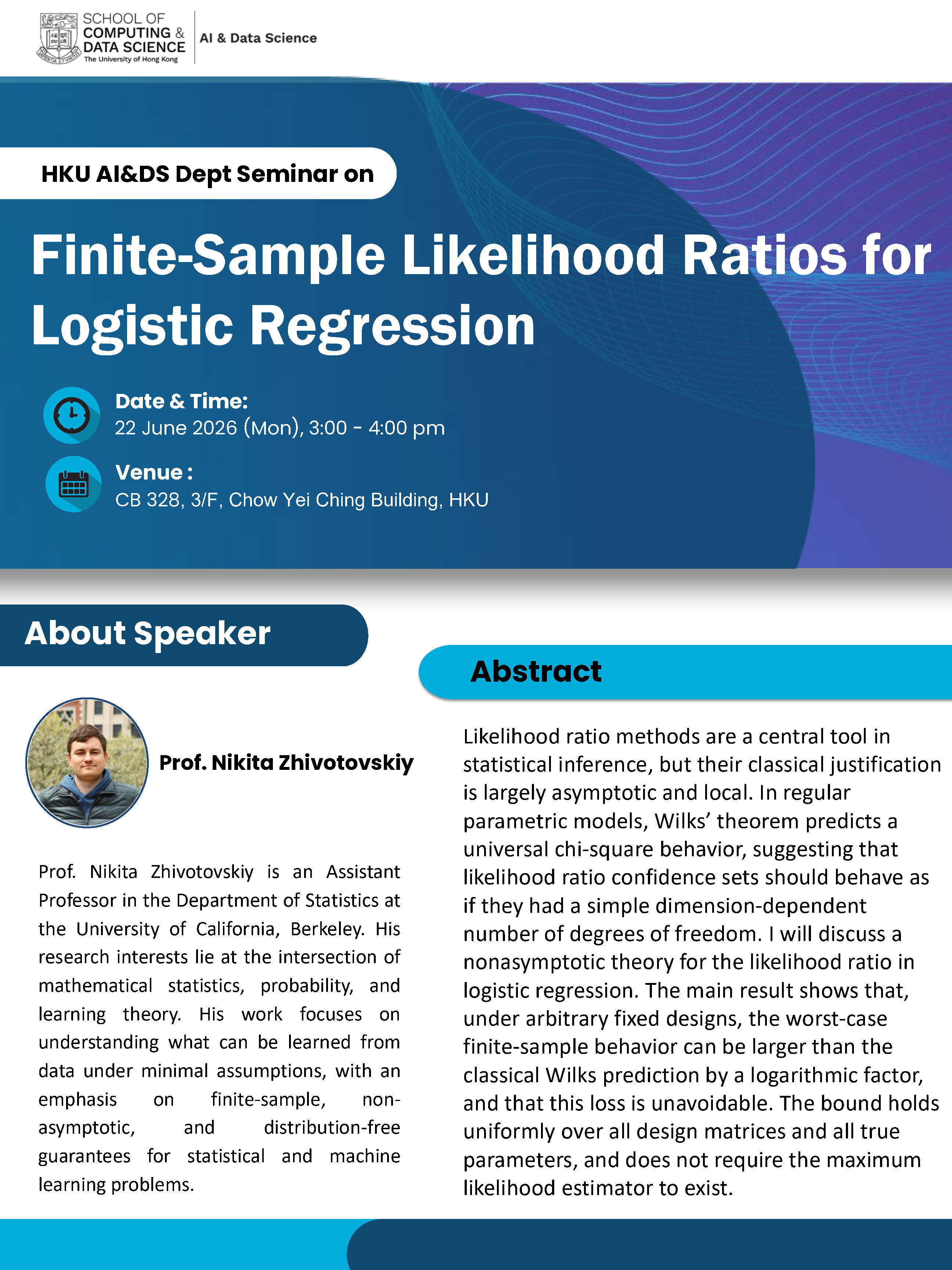
Title: Finite-Sample Likelihood Ratios for Logistic Regression
Time: 03:00pm
Venue: CB328, 3/F, Chow Yei Ching Building, HKU
Speaker(s): Prof. Nikita Zhivotovskiy
Remark(s): Abstract
Likelihood ratio methods are a central tool in statistical inference, but their classical justification is largely asymptotic and local. In regular parametric models, Wilks’ theorem predicts a universal chi-square behavior, suggesting that likelihood ratio confidence sets should behave as if they had a simple dimension-dependent number of degrees of freedom. I will discuss a nonasymptotic theory for the likelihood ratio in logistic regression. The main result shows that, under arbitrary fixed designs, the worst-case finite-sample behavior can be larger than the classical Wilks prediction by a logarithmic factor, and that this loss is unavoidable. The bound holds uniformly over all design matrices and all true parameters, and does not require the maximum likelihood estimator to exist.
About the speaker
Prof. Nikita Zhivotovskiy is an Assistant Professor in the Department of Statistics at the University of California, Berkeley. His research interests lie at the intersection of mathematical statistics, probability, and learning theory. His work focuses on understanding what can be learned from data under minimal assumptions, with an emphasis on finite-sample, non-asymptotic, and distribution-free guarantees for statistical and machine learning problems.
|
| June 18, 2026 |
-
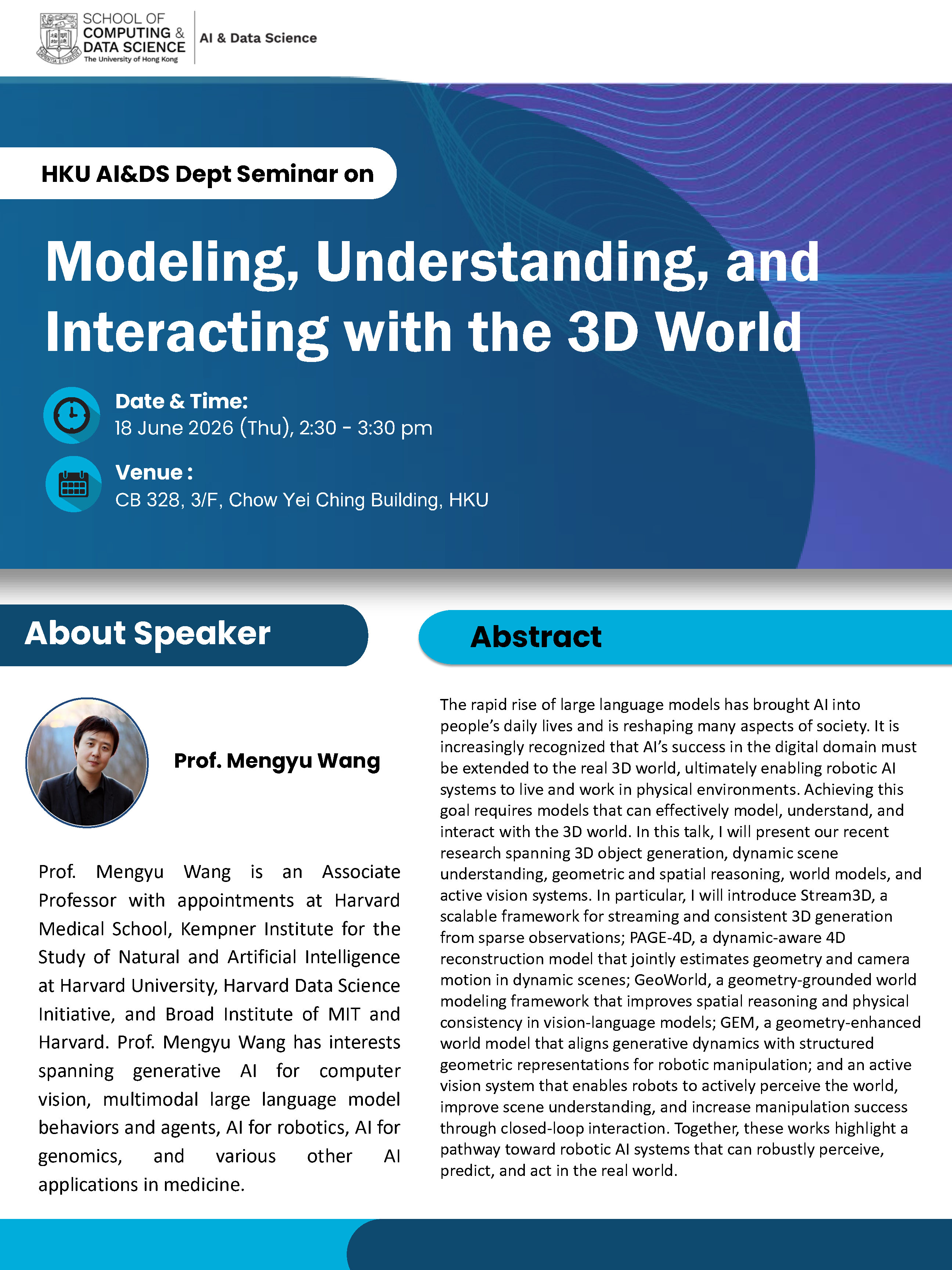
Title: Modeling, Understanding, and Interacting with the 3D World
Time: 02:30pm
Venue: CB328, 3/F, Chow Yei Ching Building, HKU
Speaker(s): Prof. Mengyu Wang
Remark(s): Abstract
The rapid rise of large language models has brought AI into people’s daily lives and is reshaping many aspects of society. It is increasingly recognized that AI’s success in the digital domain must be extended to the real 3D world, ultimately enabling robotic AI systems to live and work in physical environments. Achieving this goal requires models that can effectively model, understand, and interact with the 3D world. In this talk, I will present our recent research spanning 3D object generation, dynamic scene understanding, geometric and spatial reasoning, world models, and active vision systems. In particular, I will introduce Stream3D, a scalable framework for streaming and consistent 3D generation from sparse observations; PAGE-4D, a dynamic-aware 4D reconstruction model that jointly estimates geometry and camera motion in dynamic scenes; GeoWorld, a geometry-grounded world modeling framework that improves spatial reasoning and physical consistency in vision-language models; GEM, a geometry-enhanced world model that aligns generative dynamics with structured geometric representations for robotic manipulation; and an active vision system that enables robots to actively perceive the world, improve scene understanding, and increase manipulation success through closed-loop interaction. Together, these works highlight a pathway toward robotic AI systems that can robustly perceive, predict, and act in the real world.
About the speaker
Prof. Mengyu Wang is an Associate Professor with appointments at Harvard Medical School, Kempner Institute for the Study of Natural and Artificial Intelligence at Harvard University, Harvard Data Science Initiative, and Broad Institute of MIT and Harvard. Prof. Mengyu Wang has interests spanning generative AI for computer vision, multimodal large language model behaviors and agents, AI for robotics, AI for genomics, and various other AI applications in medicine.
|
| June 17, 2026 |
-
Title: Optimal Reinsurance Maximising Dividends: A Discretetime Dynamic Problem and Numerical Results
Time: 02:00pm
Venue: RR301, Run Run Shaw Building
Speaker(s): Prof. Debora Daniela Escobar
Remark(s): Abstract
We formulate the optimal reinsurance problem maximising cumulative dividend payments in discrete-time, where our decision is the ceding loss function for each stage. Reinsurance is applied to the aggregated loss of each stage, and the reinsurance premium is given by a distortion risk measure. Considering also dividends as part of the decision variable, we maximise our objective under (a) the surplus, and (b) adding a solvency constraint that controls the ruin probability. Thirdly, we solve a last problem, (c) under both constraints when dividends are given by a pre-specified dividend rule. Problems (a)-(b) reduce to solving unconstrained static problems. We find multi-layered optimal policies by minimising the expected loss of the insurer for each stage, moreover, (b) offers a dividend rule that caps the surplus. In contrast, the optimal policy for (c) with the barrier dividend rule can be found by solving constrained problems for each stage, where the constraint imposes an upper bound to the retained losses. We obtain multilayered policies and propose a Linear Programming (LP) to approximate its deductibles. We show results for the Expected value, Value-at-Risk, Average-Value-at-Risk and Glue Value-atRisk. The deductibles we estimate show a relationship with the distortion, the barrier, and the income of the insurer.
About the speaker
"I joined the Department of Actuarial Mathematics and Statistics in Heriot-Watt University in September 2023. Previously, I was an Assistant Professorial Lecturer in the Department of Statistics in the London School of Economics (LSE), where I was the Program Director of the BSc Actuarial Science. I initially joined LSE as a Fellow in the same department following my PhD. I completed my PhD in the Department of Statistics and Operations Research, at the University of Vienna, under the supervision of Prof Georg Ch. Pflug. I have an MSc in Statistical and Computational Data Analytics from the Complutense University of
Madrid and the Technical University of Madrid. I hold a BSc in Mathematics from the Complutense University of Madrid."

|
| June 16, 2026 |
-
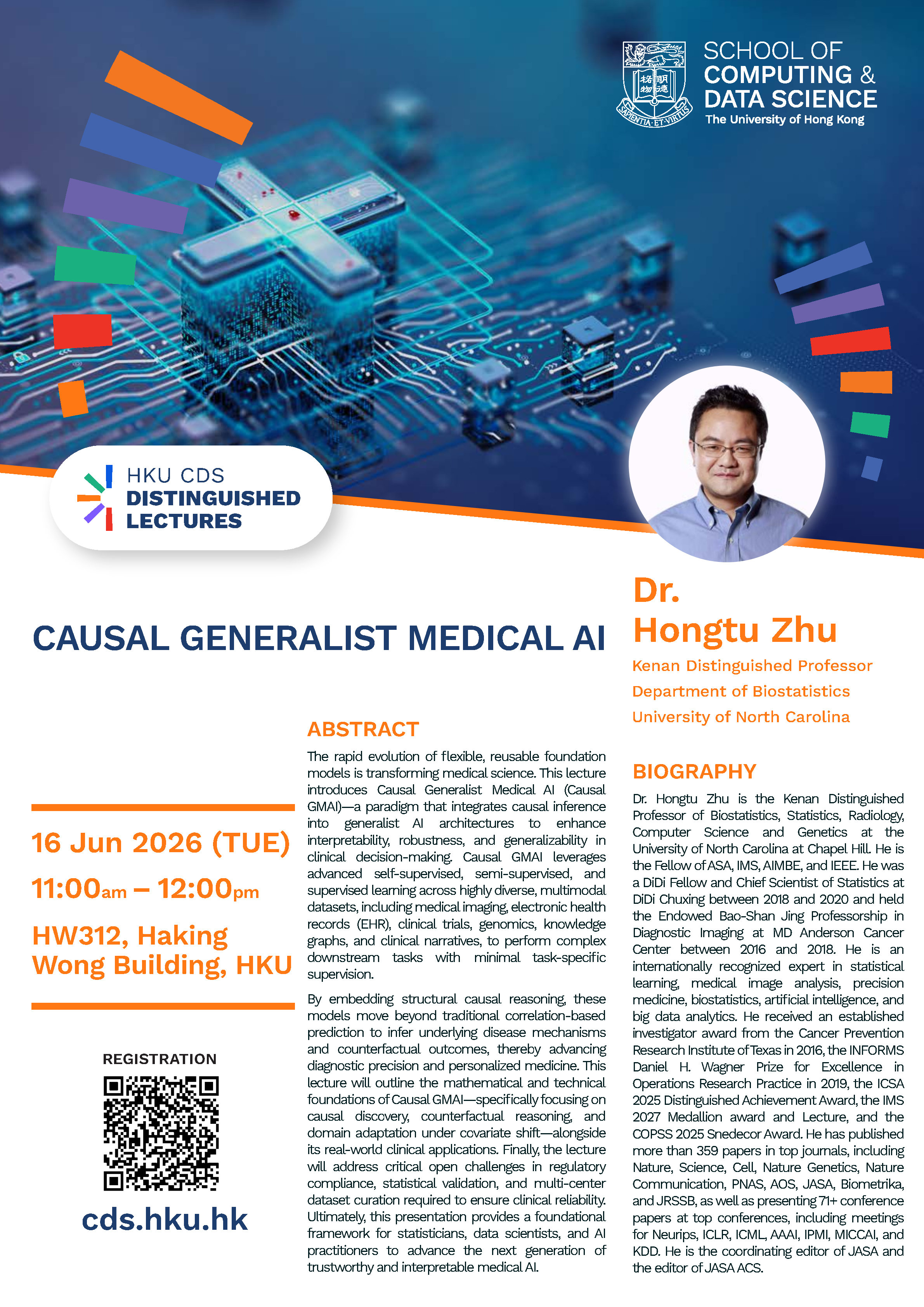
Title: Causal Generalist Medical AI
Time: 11:00am
Venue: HW312, Haking Wong Building or Lecture theater 1A, G/F, CDS-1 Building, HKU-CDS Shanghai Teaching and Research Site
Speaker(s): Dr. Hongtu Zhu
Remark(s): Abstract
"The rapid evolution of flexible, reusable foundation models is transforming medical science. This lecture introduces Causal Generalist Medical AI (Causal GMAI)—a paradigm that integrates causal inference into generalist AI architectures to enhance
interpretability, robustness, and generalizability in clinical decision-making. Causal GMAI leverages advanced self-supervised, semi-supervised, and supervised learning across highly diverse, multimodal datasets, including medical imaging, electronic health
records (EHR), clinical trials, genomics, knowledge graphs, and clinical narratives, to perform complex downstream tasks with minimal task-specific supervision.
By embedding structural causal reasoning, these models move beyond traditional correlation-based prediction to infer underlying disease mechanisms and counterfactual outcomes, thereby advancing diagnostic precision and personalized medicine. This
lecture will outline the mathematical and technical foundations of Causal GMAI—specifically focusing on causal discovery, counterfactual reasoning, and domain adaptation under covariate shift—alongside its real-world clinical applications. Finally, the lecture will address critical open challenges in regulatory compliance, statistical validation, and multi-center dataset curation required to ensure clinical reliability. Ultimately, this presentation provides a foundational framework for statisticians, data scientists, and AI practitioners to advance the next generation of trustworthy and interpretable medical AI."
About the speaker
"Dr. Hongtu Zhu is the Kenan Distinguished Professor of Biostatistics, Statistics, Radiology, Computer Science and Genetics at the University of North Carolina at Chapel Hill. He is the Fellow of ASA, IMS, AIMBE, and IEEE. He was a DiDi Fellow and Chief Scientist of Statistics at DiDi Chuxing between 2018 and 2020 and held the Endowed Bao-Shan Jing Professorship in Diagnostic Imaging at MD Anderson Cancer Center between 2016 and 2018. He is an internationally recognized expert in statistical
learning, medical image analysis, precision medicine, biostatistics, artificial intelligence, and big data analytics. He received an established investigator award from the Cancer Prevention Research Institute of Texas in 2016, the INFORMS Daniel H. Wagner Prize for Excellence in Operations Research Practice in 2019, the ICSA 2025 Distinguished Achievement Award, the IMS
2027 Medallion award and Lecture, and the COPSS 2025 Snedecor Award. He has published more than 359 papers in top journals, including Nature, Science, Cell, Nature Genetics, Nature Communication, PNAS, AOS, JASA, Biometrika,
and JRSSB, as well as presenting 71+ conference papers at top conferences, including meetings for Neurips, ICLR, ICML, AAAI, IPMI, MICCAI, and KDD. He is the coordinating editor of JASA and the editor of JASA ACS."
-
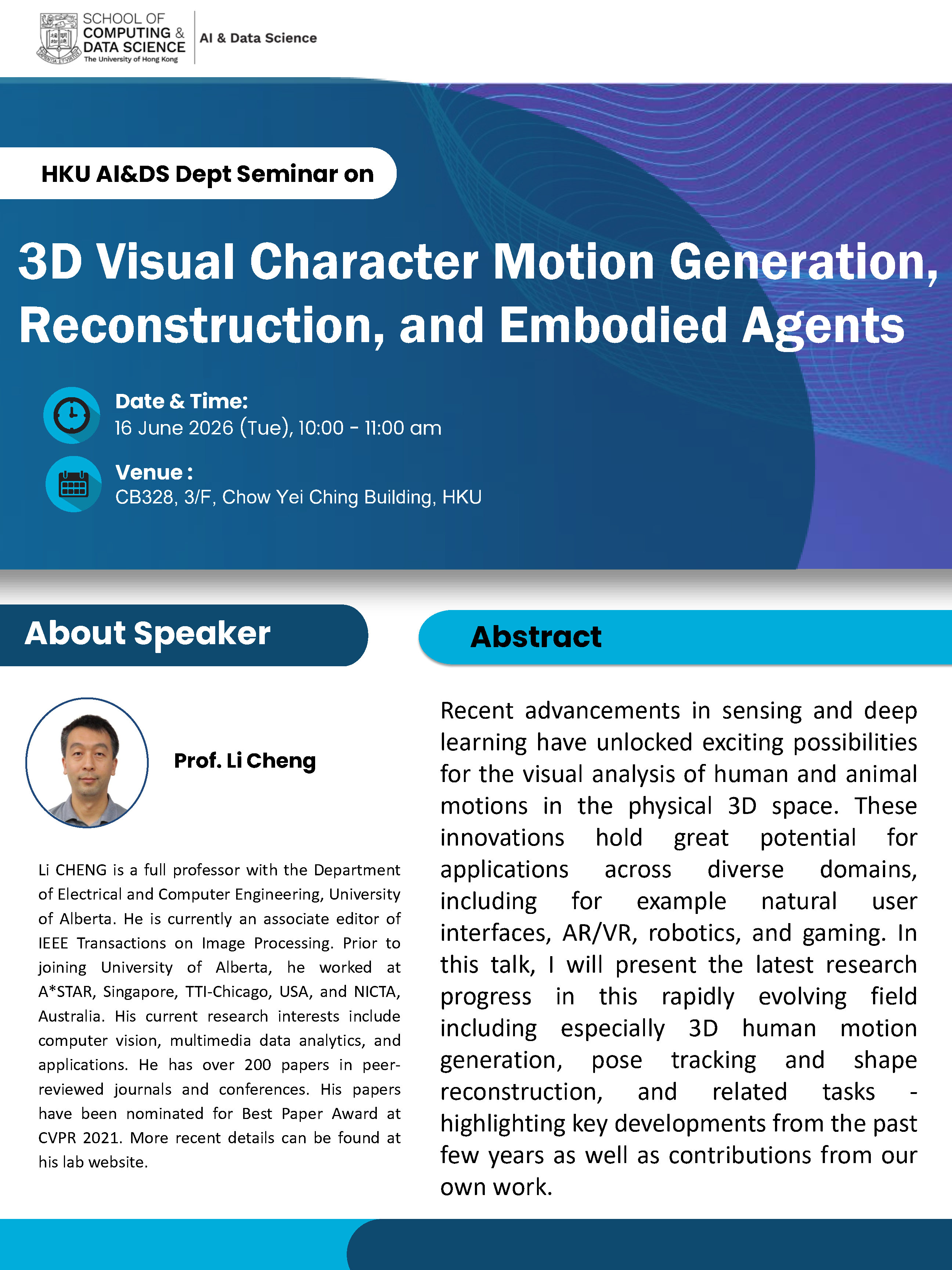
Title: 3D Visual Character Motion Generation, Reconstruction, and Embodied Agents
Time: 10:00am
Venue: CB328, 3/F, Chow Yei Ching Building, HKU
Speaker(s): Prof. Li Cheng
Remark(s): Abstract
"Recent advancements in sensing and deep learning have unlocked exciting possibilities for the visual analysis of human and animal motions in the physical 3D space. These innovations hold great potential for applications across diverse domains, including for example natural user interfaces, AR/VR, robotics, and gaming. In this talk, I will present the latest research progress in this rapidly evolving field including especially 3D human motion generation, pose tracking and shape reconstruction, and related tasks - highlighting key developments from the past few years as well as contributions from our own work."
About the speaker
Li CHENG is a full professor with the Department of Electrical and Computer Engineering, University of Alberta. He is currently an associate editor of IEEE Transactions on Image Processing. Prior to joining University of Alberta, he worked at A*STAR, Singapore, TTI-Chicago, USA, and NICTA, Australia. His current research interests include computer vision, multimedia data analytics, and applications. He has over 200 papers in peer-reviewed journals and conferences. His papers have been nominated for Best Paper Award at CVPR 2021. More recent details can be found at his lab website
|
| June 15, 2026 |
-
Title: Differentially private one-shot model-free screening with FDR control
Time: 04:00pm
Venue: RR301, Run Run Shaw Building
Speaker(s): Prof. Linglong Kong
Remark(s): Abstract
Selection with privacy protection is increasingly important in high-dimensional data, particularly where data retains important yet sensitive information. In this paper, we propose a Safe Differentially Private model-free variable screening framework (SDPscreen) and further provide a private data-adaptive threshold with controlled false discovery rate (FDR) for high-dimensional sensitive data. Our private strategy is constructed upon the (boosted) Chatterjee's rank coefficient by incorporating a oneshot peeling algorithm. Our method is fully non-parametric, enabling the detection of non-linear and non-monotone associations without imposing the bounded conditions for privacy protection. We establish both algorithmic privacy guarantees and screening properties, and the private data-adaptive selection demonstrates the capability for FDR control under mild theoretical conditions. Extensive numerical experiments and a real-world application confirm that our methods outperform state-of-the-art approaches in terms of both screening accuracy and privacy efficiency.
About the speaker
Dr. Linglong Kong is a Professor in the Department of Mathematical and Statistical Sciences at the University of Alberta, holding a Canada Research Chair in Statistical Learning and a Canada CIFAR AI Chair. He is a Fellow of the American Statistical Association (ASA) and the Alberta Machine Intelligence Institute (Amii), with over 150 peer-reviewed publications in leading journals and conferences such as AOS, JASA, JRSSB, NeurIPS, ICML, and ICLR. Dr. Kong received the 2025 CRM-SSC Prize for outstanding research in Canada. He serves as Associate Editor for several top journals, including JASA and AOAS, and has held leadership roles within the ASA and the Statistical Society of Canada. Dr. Kong’s research interests include high-dimensional and neuroimaging data analysis, statistical machine learning, robust statistics, quantile regression, trustworthy machine learning, and artificial intelligence for smart health.

|
| June 12, 2026 |
-
Title: A General Framework For Multiple Testing Via E-Value Aggregation And Data-Dependent Weighting
Time: 02:00pm
Venue: Room 301, Run Run Shaw Building
Speaker(s): Dr. Guanxun Li
Remark(s): Abstract
"Motivated by recent findings in Li and Zhang (2025), which establish an equivalence between certain $p$-value–based multiple testing procedures and the e–Benjamini–Hochberg procedure, we develop a general framework for constructing new multiple testing methods via aggregation and combination of e-values. A direct aggregation or combination can yield negligible power in
practice; therefore, we introduce data-dependent weighting for e-value aggregation and combination, which significantly improves the power of the resulting e–Benjamini–Hochberg procedures. Designing these weights is nontrivial and is inspired by leave-one-out analyses, a technique widely used to prove false discovery rate control in $p$-value–based methods. We theoretically show that the proposed e–Benjamini–Hochberg procedure, when equipped with data-dependent weights, achieve finite-sample FDR control. Building on these weights, we propose new procedures for three distinct scenarios: (i) assembling e-values obtained from
different data subsets, with simultaneous control of group-wise and overall FDRs; (ii) aggregating e-values produced by different procedures; and (iii) adaptive multiple testing methods that incorporate external structural information to increase power. Numerical studies demonstrate the effectiveness and advantages of the proposed methods in each application scenario."
About the speaker
Dr. Guanxun Li is an Assistant Professor in the Department of Statistics at Beijing Normal University, Zhuhai Campus. He earned his Ph.D. in Statistics from Texas A&M University in 2022. His research focuses on multiple testing, watermarking in large language models, Bayesian computation, and biostatistics.

|
